Spatially aware clustering for exploration: insights from the Moon
This post is the result of a collaboration between Datarock and Lunarlab, a lunar-focused research initiative within the Frontier Development Lab (FDL). Lunarlab is developing Lunar-FM, the first AI foundation model for lunar exploration and resource prospecting, using multi-modal orbital datasets. Datarock’s contribution was to bring geophysical and geological domain expertise, working with these embeddings to produce spatial outputs that are interpretable and actionable. We’re grateful for the opportunity to collaborate on a problem at the intersection of advanced machine learning and applied geoscience.
TL;DR: Self-supervised learning is a machine learning technique commonly used in Computer Vision that is revolutionising how we analyse geophysical and satellite imagery. By transforming multiple datasets into compact numerical representations (embeddings), they allow us to detect subtle geological variation across large areas without the need for labelled training data (for more information, read Thomas Schaap’s blog onHarnessing the power of Computer Vision in geophysics).
But generating embeddings is only half the challenge. The other half is organising them into spatially coherent geological domains that can be interpreted and acted on. Many clustering approaches are used to do this. While they may work well in feature space, they can often produce fragmented spatial outputs that are difficult to interpret geologically.
This post demonstrates a spatially aware clustering approach, using embeddings from Lunarlab’s lunar foundation model to define sub-units of the lunar geological map within the basaltic lava flows of the Mare Tranquillitatis (Sea of Tranquillity) unit at the Lunar equator. Analysis of this nature is critical in supporting the upcoming lunar missions and ultimately a more permanent presence on the moon.
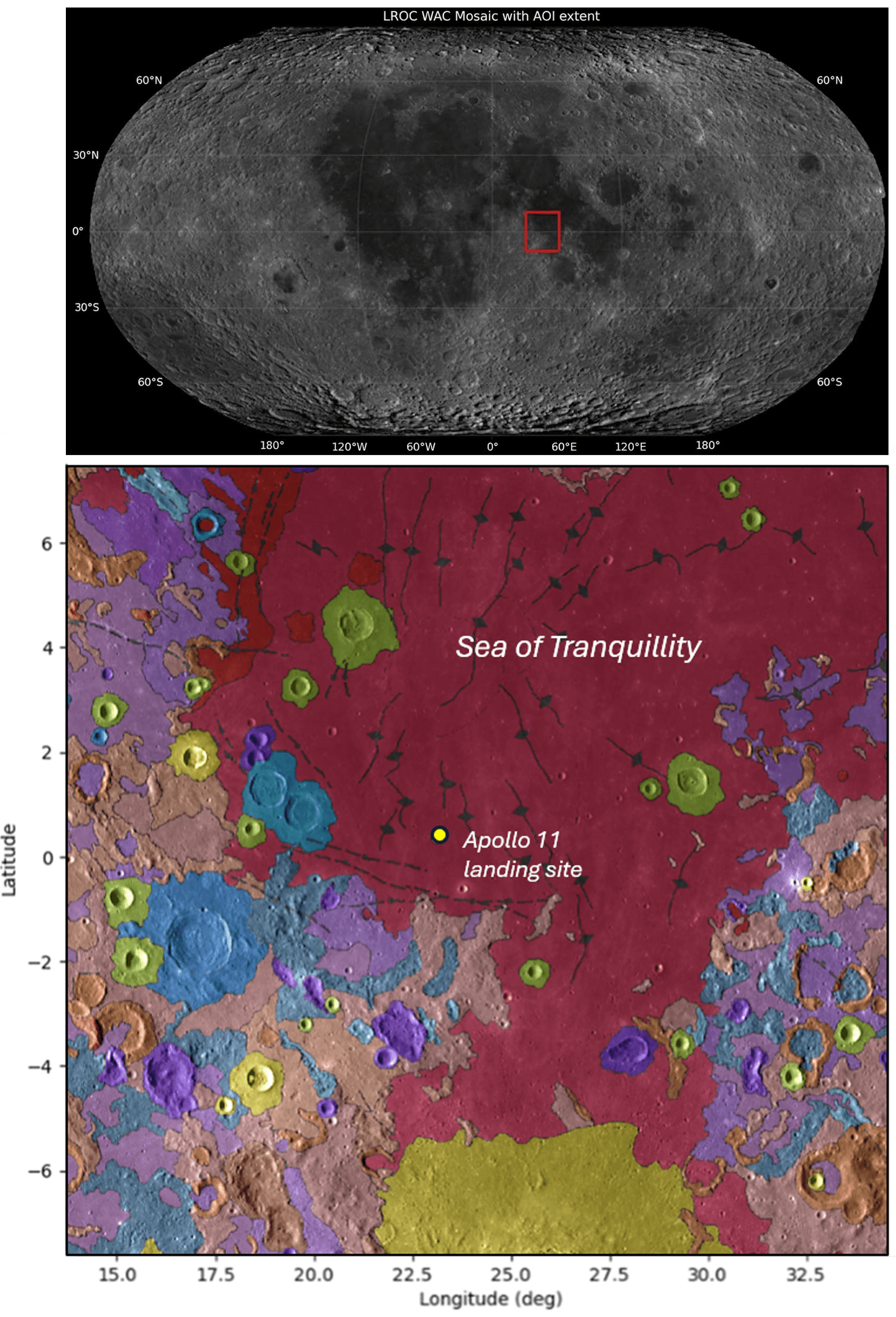
Figure 2: 1:5M Unified Geological map of the Moon overlain on the LROC Wide Angle Camera (WAC) mosaic. The large red unit in the centre of the AOI corresponds to the Sea of Tranquillity.